
Your AC breaks down on a July afternoon in Houston. A technician gives you a repair quote, and suddenly you’re staring at a number that makes you wonder: is this system even worth fixing anymore? If you’re trying to figure out when to replace your AC unit, you’re asking the right question, and it deserves a straight answer, not a sales pitch. It’s one of the most common questions we hear at Titan Pro Services during service calls across Greater Houston.
The honest truth is there’s no single magic number that automatically tips the decision one way or the other. But there are four signals that, when they show up together, consistently point toward replacement over another repair: how old the system is, how often it’s breaking down, what it’s doing to your energy bills, and whether it still runs on R-22 refrigerant. Knowing how to read those signals is what separates a confident decision from an expensive guess.
This article walks you through each one. No sales pressure, no vague advice. Just the information you need to make a call you won’t second-guess later.
When to Replace Your AC Unit: Age and Lifespan
The 15-to-20-year lifespan benchmark
Central air conditioners are built to last between 15 and 20 years with proper maintenance. Well-maintained systems often hit the high end of that range; neglected ones fall well short. Some manufacturers quote a range of 12 to 17 years, but the practical benchmark the HVAC industry uses is 15 years as the point where you should start evaluating your options seriously.
Age alone isn’t an automatic death sentence. A 16-year-old unit that runs efficiently, rarely breaks down, and cools your home without straining isn’t necessarily a unit you need to rush to replace. But age is the foundation of every replacement decision, because it changes how you interpret every other signal.
Why Houston’s climate shortens that window
In Houston, AC units run longer and harder than in almost any other U.S. market. Summers regularly push past 95°F, humidity keeps systems working overtime well into October, and a Houston unit can log somewhere between 2,800 and 3,200 operating hours per year, significantly more than systems in milder climates. That continuous demand adds wear that simply doesn’t accumulate in cooler markets.
A Houston unit may perform like a much older system compared to its same-age counterpart in a cooler state. The realistic lifespan for a Houston central AC with regular maintenance lands closer to 12 to 15 years, with well-maintained systems sometimes stretching to 16 or 17. If your unit is past 12 years old and showing any of the other warning signs discussed below, take those signs more seriously than you might otherwise.
When to Replace Your AC Unit: Repair Costs vs. Replacement
The 50% rule for cumulative repair costs
The most useful rule of thumb we apply is this: when your repair costs approach 50% of what a new system would cost installed, replacement is the smarter financial move. It’s a simple test. Get the repair estimate, get a replacement quote, and compare them against that threshold.
For context, a new central AC installation in the Houston area commonly ranges from $4,000 to $8,000 depending on system size, efficiency tier, and installation complexity. That means the 50% threshold lands somewhere between $2,000 and $4,000 in cumulative repairs. A single large repair, like a compressor replacement on a 14-year-old unit, can cross that line on its own. When you’re approaching or past that mark on an aging system, you’re paying to extend a unit that’s already in decline.
Repair frequency as an independent warning signal
Beyond the total dollar amount, the pattern of repairs tells its own story. A reliable unit should go years between issues with routine maintenance. If your system has needed service three or more times in a single season, or keeps failing at the same component, that frequency signals a system in decline, not a string of unrelated bad luck.
Repeated breakdowns are the system telling you something that maintenance alone can’t fix. When that pattern shows up on a unit that’s already past its prime, the frequency of failures is as meaningful as the cost of any single repair.
What rising energy bills are really telling you
How aging AC units lose efficiency over time
AC systems lose efficiency gradually as they age, even with regular tune-ups. Worn compressor components, degraded refrigerant charge, and coil buildup all reduce how effectively the system converts electricity into cooling. The output goes down while the electricity consumption stays the same or climbs.
A 15-year-old unit originally rated at SEER 8 or 10 is likely performing below even that rating today. Efficiency degradation is a known byproduct of normal mechanical wear, and older systems are especially vulnerable to it. You end up paying for more electricity and getting less cooling than when the unit was new. If your summer bills have crept up noticeably without a clear explanation, like higher electricity rates or a bigger household, the aging system is a logical suspect.
The real dollar savings a modern SEER rating delivers
Upgrading from a SEER 10 system to a SEER 16 unit can cut your cooling energy consumption by around 30%. In Houston’s hot-climate conditions, that often translates to $300 to $500 per year in electricity savings for a typical household. Some homeowners see more, depending on home size, insulation, and how heavily they run the system.
In a climate where AC runs eight or nine months a year, those savings add up fast. A new, efficient system isn’t just an expense, it starts returning value from the first month of operation. Framed over the 15-to-20-year lifespan of a new unit, the energy savings can offset a significant portion of the upfront replacement cost.
Why R-22 refrigerant is making older systems expensive to keep
R-22 is no longer manufactured or imported
As of 2020, R-22 (also known as Freon) was banned from U.S. production and import. Any R-22 available in 2026 comes from reclaimed or recycled stock only. That limited supply creates volatile pricing: R-22 currently runs approximately $80 to $250 per pound depending on your market, contractor, and local availability, and prices have continued to climb as reclaimed inventory shrinks. A system with a refrigerant leak can easily require $750 to $1,500 or more just to recharge, before factoring in the cost of diagnosing and repairing the leak itself.
Homeowners aren’t required to replace a working R-22 system. An existing unit can still be serviced with reclaimed refrigerant, and nothing in current EPA rules forces your hand. The pressure comes from the math: every service call on an R-22 system costs significantly more than it did five years ago, and that gap will only grow as reclaimed supply continues to shrink.
When the refrigerant situation makes the decision easy
If your R-22 system develops a compressor failure or a significant refrigerant leak, the repair cost calculation often makes replacement the clear choice. Parts for older R-22 equipment are increasingly difficult to source, and paying premium refrigerant prices to sustain an already-aging system rarely makes financial sense when modern systems are more efficient and use current-standard refrigerants.
A compressor replacement on a unit that will then require expensive R-22 to operate is a scenario where both the 50% rule and the refrigerant situation point in the same direction. When that happens, deciding whether to replace your air conditioner becomes much more straightforward.
Other signals your system is waving a white flag
Comfort and airflow problems that don’t go away
Uneven cooling, rooms that never reach the set temperature, and weak airflow from vents are signs the system can no longer perform its job consistently. These symptoms can have isolated causes, like a clogged filter or partially blocked duct, but when they persist after maintenance on a unit past 12 years old, they usually reflect a system in decline rather than a single fixable problem. Two service calls in one season with the same comfort issues returning each time is a pattern worth taking seriously, not explaining away.
Noises, smells, and moisture problems
Grinding, banging, or squealing noises point to mechanical wear inside the unit. Musty smells often signal mold or mildew buildup in the system; burning smells can indicate failing electrical components. Water pooling around the indoor unit is another common late-stage symptom, often related to a clogged drain or a failing condensate system.
Individually, many of these issues have repair solutions. But stacked on top of age, efficiency loss, and rising repair costs, they build a clear case for replacement rather than another round of fixes on a system that’s running out of useful life.
How to make this decision without second-guessing yourself
What a good evaluation actually looks like
Before committing to either a repair or a replacement, you need specific information: what’s wrong, what it costs to fix, and what the system’s remaining useful life realistically looks like. Without those numbers in writing, you’re making a major financial decision without the data it requires. A proper diagnostic produces that documentation and lets you compare the cost of repair against the cost of replacement on an apples-to-apples basis.
Homeowners shouldn’t have to choose between a technician pushing repairs and one pushing a new unit. A straightforward written assessment gives you the numbers and lets you decide without pressure from either direction.
When you’re still not sure, start with a diagnostic
If you’re unsure after working through these signals, a no-pressure consultation with a licensed technician is the right next step. At Titan Pro Services, that starts with a flat $79 diagnostic that includes a full 21-point inspection, a written summary of findings, and a clear presentation of your options, no sales agenda attached.
You walk away knowing exactly where your system stands and what each path forward actually costs. No vague estimates, no pressure to decide on the spot. If you want to know exactly where your system stands before spending another dollar on repairs, our diagnostic is the right starting point. The decision stays yours, made with the full picture in front of you.
Making the call with confidence
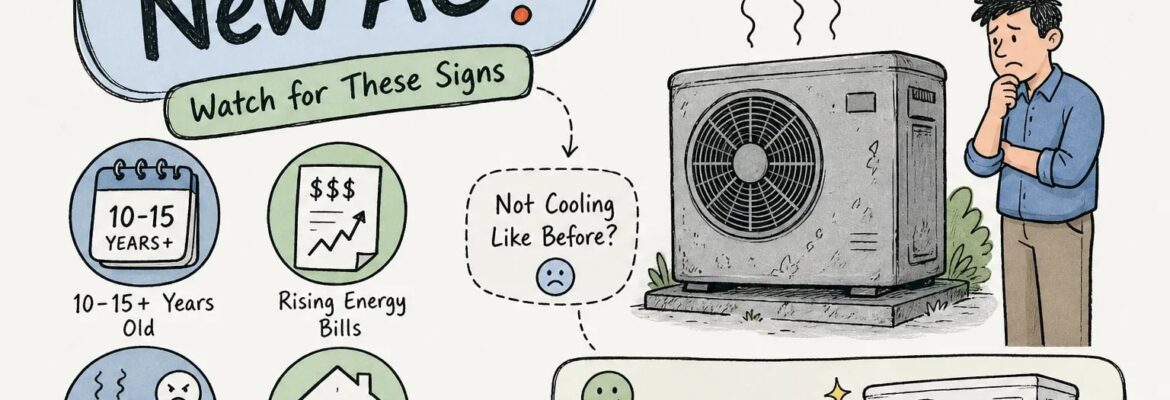
The four core signals to watch are: a unit past 15 years old, repair costs approaching 50% of what a new system would cost, energy bills climbing without another clear cause, and a system still running on R-22 refrigerant. No single signal is always the definitive answer on its own. Two or more showing up together is a strong indicator that replacement is the smarter long-term investment.
This is a significant purchase decision, and you deserve clear information rather than pressure from either side. Get a proper diagnostic before committing to another repair or a full replacement. The numbers will tell you what the signals are already suggesting.
A properly sized, high-efficiency system installed today will run for the next 15 to 20 years. In Houston’s climate, the energy savings start showing up on the first monthly bill. Knowing when to replace your AC unit isn’t about guessing, it’s about reading the signals your system has been sending you.
Leave A Comment