
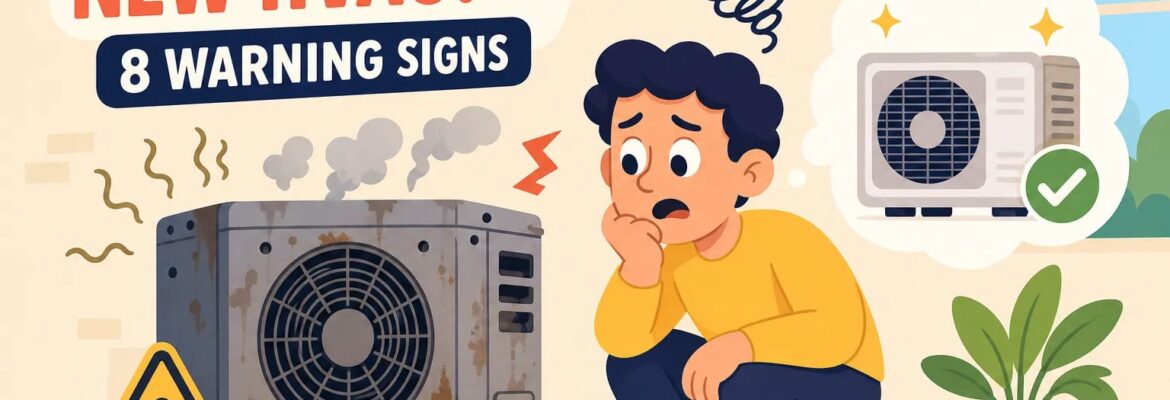
Picture this: it’s a Tuesday afternoon in late July, the thermometer outside reads 98°F, and your AC has been running since dawn. You open the electricity bill and feel your stomach drop. The system is working, technically, but something feels off. The house never quite cools down, the humidity is suffocating, and the compressor outside sounds like it’s auditioning for a percussion section.
These old HVAC system signs are easy to dismiss one at a time, but together, they tell a clear story. Many Houston homeowners only notice a failure when the system stops completely on the hottest day of the year. At Titan Pro Services, we’ve inspected a high volume of aging units across Greater Houston, and the warning signs are almost always present months before the breakdown. Knowing what to look for changes everything. Here are eight concrete signals that your system may be past its prime, along with the thresholds that separate a repair worth making from one that isn’t.
Old HVAC System Signs: Age and Repair History Working Against You
Sign 1: The System Has Crossed the 10, 15 Year Mark
Central air conditioners typically last 12, 15 years. Furnaces run 15, 25 years. Heat pumps fall in the 10, 15 year range. Age alone doesn’t doom a system, but it fundamentally changes how you should evaluate every repair quote you receive. A 14-year-old system with a $1,200 repair bill is a very different conversation than the same repair on a 4-year-old unit.
Houston’s climate makes this more urgent than national averages suggest. The extreme heat and relentless humidity here mean your AC runs far longer than systems in cooler climates, often 2,500 to 3,500 hours per year. That kind of workload accelerates wear on compressors, motors, and coils, pushing many Greater Houston systems to their limits on the earlier end of those lifespan ranges. A system installed in 2011 is now about 15 years old, which approaches or exceeds the typical AC lifespan for Houston’s climate.
Sign 2: You’ve Called for Repairs More Than Twice in One Year
Repair frequency is one of the clearest signals a system is approaching the end of its useful life. The general industry rule: if a system needs three or more significant repairs within a 24-month window, replacement is almost always the better financial move. A helpful filter is the $5,000 rule, multiply the system’s age by the cost of the repair. If the result exceeds $5,000, replace.
Consider a concrete example: a 13-year-old AC with a $450 repair quote gives you $5,850. That crosses the threshold. Compare that to a 5-year-old system with the same repair: $2,250, well within repair territory. The math is simple, and it takes the emotion out of a stressful decision.
Energy Bills and Home Comfort Sending Clear Signals
Sign 3: Monthly Energy Costs Keep Climbing for No Obvious Reason
An aging HVAC system doesn’t just struggle to cool your home, it costs more to do it. Systems that are 10 to 15 years old typically use 20, 40% more energy than a modern high-efficiency replacement. For many Houston households, that translates to $300, $800 extra per year just to run equipment that’s past its prime.
The efficiency difference is worth understanding in plain terms. An older 10 SEER unit compared to a new 16 SEER2 system means roughly 37% less energy for the same cooling output. New units sold in Texas today must meet at least 14.3 SEER2 for most split systems, with many homeowners choosing 16, 18 SEER2 for better long-term savings. That gap between what your old system consumes and what a new one would is essentially a hidden monthly fee you’re paying to keep aging equipment running, one that compounds every billing cycle.
Sign 4: Some Rooms Are Always Too Hot or Too Cold
Uneven temperatures throughout the house are a sign that something has changed in how your system moves air. As HVAC equipment ages, it loses the capacity to distribute conditioned air consistently, whether from reduced compressor output, a struggling blower motor, or refrigerant loss that limits cooling capacity.
Uneven comfort isn’t always a system failure on its own. Sometimes it’s a duct problem, not the unit itself. But in a system that’s 12 or more years old, uneven heating or cooling combined with any other sign on this list warrants a professional evaluation. That pattern deserves a technician’s assessment, not a shrug.
Strange Noises, Smells, and Humidity Problems You Shouldn’t Ignore
Sign 5: Banging, Rattling, Squealing, or Grinding That Wasn’t There Before
Unusual sounds from an HVAC system are never random. Banging or clanking typically points to a loose or failing compressor. Squealing usually means a worn blower motor bearing or, in older belt-driven systems, a slipping belt. Grinding is most often a motor bearing problem that’s well past the point of waiting.
None of these sounds are safe to ignore. Delaying service on an aging system typically increases the repair scope, because one failing component forces others to absorb the extra load and accelerates the overall decline. A noisy HVAC system isn’t just an annoyance, it’s a system telling you something is breaking down. The sooner you get a technician to assess it, the more options you have.
Sign 6: Humidity Feels Worse Inside and Air Quality Has Dropped
One of the less obvious old HVAC system signs is its inability to properly dehumidify your home. Houston’s climate is notoriously humid, summers regularly bring some of the highest dew points in the continental U.S. When an AC system loses dehumidification capacity, the result is that heavy, sticky feeling inside even when the thermostat says it’s cooling.
Beyond discomfort, there are real health consequences. High indoor humidity promotes mold growth and increases dust mite populations. Health organizations typically recommend maintaining indoor relative humidity between 40% and 60%. An aging system that can’t hold that range isn’t just uncomfortable, it’s a genuine indoor air quality problem. If you’re also noticing musty odors or visible moisture near vents, your HVAC system deserves a close look.
Worsening respiratory symptoms at home can also signal a humidity control problem. In that case, a professional assessment of your system’s dehumidification performance is the right next step.
The Refrigerant and Peak-Day Performance Problem
Sign 7: Your System Still Runs on R-22 Refrigerant
If your AC was installed before 2010, there’s a strong chance it uses R-22, commonly known as Freon. The production and import of R-22 was banned in 2020, which means only reclaimed and recycled supply remains on the market. That limited supply has pushed prices to roughly $90, $300 or more per pound, and availability isn’t guaranteed to improve.
If your R-22 system is running fine with no leaks, you don’t need to panic. But a refrigerant leak in an R-22 system changes the math entirely. A single service call can cost several hundred dollars just for the refrigerant charge, before any repair labor is factored in. An R-22 leak in an aging system is one of the clearest replacement triggers we see at Titan Pro Services. It’s rarely worth paying premium prices for reclaimed refrigerant to prop up equipment that’s already near the end of its life.
Sign 8: The System Can’t Keep Up on the Hottest Days
There’s a specific failure pattern worth recognizing: on the days when temperatures push past 95°F, your system runs continuously but the house never reaches the set temperature. This isn’t a thermostat problem. It’s a sign that the system has lost the compressor capacity to meet demand under real conditions.
This symptom can also point to refrigerant issues or a system that was never properly sized for your home and has been compensating for that mismatch for years. When peak-day performance failure combines with any two or three signs elsewhere on this list, the system is almost certainly communicating that it’s reached the end of its effective life.
How to Apply the Repair-vs-Replace Math to Your Situation
The Three Thresholds That Actually Guide the Decision
When the signs start stacking up, three filters help cut through the noise. First, is the system older than 12, 15 years? Second, does the repair cost equal more than 50% of what a new system would cost? Third, have there been multiple repairs in the past 12, 24 months? If two or three of those are true at the same time, replacement is almost always the smarter long-term financial decision.
In 2026, a full central AC and furnace replacement typically runs $7,000, $15,000 for most Houston homes, depending on system size, efficiency rating, and installation complexity. Modern high-efficiency systems can realistically save $500, $1,500 annually on energy costs compared to aging equipment. Over five years, that savings often offsets a meaningful portion of the replacement cost.
When Repair Is Still the Right Call
Replacement isn’t always the answer. If your system is under 10 years old, the repair is isolated and costs less than 30% of replacement value, and there’s no pattern of recurring breakdowns, repair is likely the right move. A good technician gives you honest criteria, not a default push toward the larger sale.
The goal isn’t to scare you into a new system. The goal is to give you the information to make a confident call before a breakdown forces a rushed decision in the middle of a Texas summer.
What a Professional Assessment Actually Looks Like
Why a Diagnostic Before Any Decision Is Non-Negotiable
Reading the signs is a starting point. Actual data is what lets you make a sound financial decision. A proper HVAC diagnostic measures refrigerant levels, electrical draw, compressor performance, airflow, and static pressure across the system. Without those numbers, you’re guessing, and guessing in either direction costs money. Homeowners who skip the diagnostic either pay for repairs a failing system doesn’t deserve or replace systems that had years left in them.
How Titan Pro’s $79 Diagnostic Takes the Guesswork Out
Titan Pro Services offers a flat $79 diagnostic and 21-point inspection that covers your full system: refrigerant levels, electrical components, airflow, coil condition, thermostat operation, and more. You get a clear written report and honest options with no pressure to commit on the spot. The $79 fee applies regardless of what we find.
For homeowners who do need replacement, financing options are available to make the decision less stressful. Our team prioritizes same-day availability so you’re not waiting out a failing system through a heatwave. And our stated policy is to base every recommendation on what your system actually needs, not on what generates the largest invoice.
One call gets you an honest assessment, a written report, and the information you need to make the right call for your home and your budget. Reach out to our team to schedule your diagnostic.
Recognizing Old HVAC System Signs Before the Next Heat Wave Hits
HVAC systems rarely fail without warning. Rising energy bills, uneven temperatures, strange noises, humidity problems, R-22 dependency, and poor peak-day performance are all old HVAC system signs worth taking seriously. When two or three of those signals appear together, the system is usually telling you something important.
The smartest move any Houston homeowner can make is to get a professional assessment before the next heat wave makes the decision for you. With Titan Pro Services’ $79 diagnostic, that assessment is straightforward, affordable, and completely pressure-free, because in a Houston summer, you deserve answers, not guesswork.
Leave A Comment