
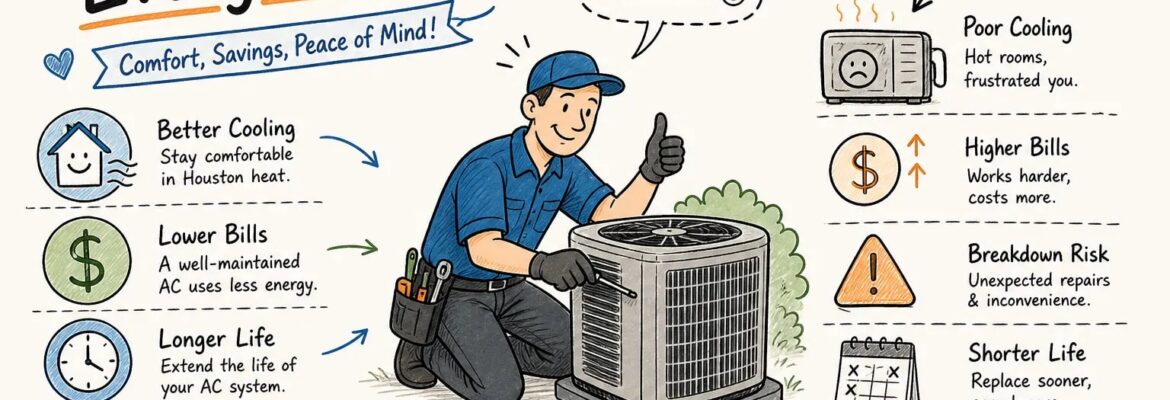
Annual AC service in Houston isn’t optional, it’s the difference between a system that holds up through summer and one that fails at the worst possible moment. Houston doesn’t give AC systems a break. With summers that push past 95°F and humidity that regularly sits above 70 percent for months at a stretch, air conditioners here log somewhere between 2,800 and 3,200 cooling hours per year. For comparison, Dallas systems average around 2,200 hours and Atlanta systems roughly 1,400. That gap represents real mechanical wear, and it explains why systems in Houston’s climate are far more vulnerable to breakdowns when routine maintenance gets skipped.
At Titan Pro Services, we’ve been servicing homes across Greater Houston and Harris County for over a decade. We inspect thousands of systems every year, and the pattern is consistent: the systems that get serviced regularly outlast and outperform those that don’t. This article gives you a clear picture of what annual AC service in Houston actually involves, when to schedule it, what it should cost, and how to pick a provider who will do the job right.
Why Houston’s climate puts more strain on AC systems than most cities
The year-round runtime reality
Houston AC systems don’t get a real off-season. While homeowners in Chicago or Minneapolis enjoy much shorter cooling seasons, systems here run eight to ten months a year without meaningful downtime. That runtime compounds wear on every component faster than manufacturers typically design for, which is why many HVAC professionals recommend more frequent service intervals for high-runtime climates like Houston’s.
The math on operating hours tells the story. A system that logs 3,000 hours annually reaches the equivalent of 20,000 lifetime hours in under seven years. That’s a meaningful amount of wear on capacitors, contactors, fan motors, and compressor windings. Annual inspections aren’t a luxury here; they’re a mechanical necessity tied directly to the number of hours your equipment puts in each year.
How humidity accelerates damage
Houston’s humidity doesn’t just make the heat feel worse. It actively damages AC components in ways that simply don’t show up in drier climates. On the evaporator coil inside your air handler, humid air is continuously cooled below its dew point, which means moisture condenses on the coil surface every time the system runs. That persistent wetness mixes with dust, VOCs, and household chemicals to create formicary corrosion on copper tubing, producing microscopic pinholes that leak refrigerant slowly and go undetected for months.
The condenser coil outside faces a different but equally aggressive problem. Moisture keeps the aluminum fins and copper tubes wet almost continuously, which creates the electrolyte layer needed for galvanic corrosion. Fins pit, degrade, and eventually lose their ability to transfer heat efficiently. As heat transfer drops, system pressures rise, and the compressor works harder to compensate. A routine annual AC inspection catches these early signs of corrosion before they turn into refrigerant loss or a failed coil.
What a thorough annual AC inspection in Houston actually covers
The major systems every technician should check
A real tune-up covers far more than swapping a filter and checking a thermostat. A technician doing the job correctly will inspect and address all of the following:
- Clean evaporator and condenser coils
- Verify refrigerant charge and check for leak points
- Tighten electrical connections
- Test capacitors and contactors
- Clear the condensate drain line and inspect the drain pan
- Evaluate blower components and airflow
- Run a full system performance test covering startup, cycling, cooling output, and shutdown
Each of these checks targets a specific failure mode that Houston’s climate accelerates. The detail matters. A clogged condensate drain line, for example, doesn’t just cause a shutdown when the float switch trips. Left long enough, it allows standing water in the pan to promote mold growth and eventually corrosion in the air handler itself. A technician who clears that line during an annual visit prevents a downstream problem that can cost far more than the tune-up. The same logic applies to every component on the checklist.
Titan Pro’s 21-point inspection
At Titan Pro Services, our annual AC service is built around a 21-point inspection that covers every major system category and documents findings in writing. That documentation matters more than most homeowners realize. A verbal summary of “everything looks fine” gives you nothing to compare against next year. A written checklist gives you a baseline, shows what was actually checked, and makes it easy to track changes in system condition over time.
When you’re evaluating any HVAC provider for an annual tune-up, ask specifically what the inspection covers and whether you’ll receive written documentation of findings. A provider who can’t answer both questions with specifics is probably offering a less thorough service than the price suggests. Use the component list above as your benchmark for what a complete visit should address.
What skipping annual service actually costs you
Tune-up pricing vs. repair pricing
A standard annual AC tune-up in Houston runs around $120 to $150 for a single system. A maintenance plan that includes two seasonal visits typically costs $150 to $300 per year, depending on what’s included. Those numbers look very different when you put them next to what routine maintenance is designed to prevent. Capacitor replacement runs $150 to $400. Refrigerant leak detection and repair ranges from $300 to $2,000 depending on where the leak is and how long it’s gone undetected. Evaporator coil replacement comes in at $1,000 to $3,500, and compressor replacement sits at $2,000 to $5,000 or more.
Research from industry organizations including ACCA and AHRI consistently finds that the large majority of major AC component failures, estimates typically range from 70 to 85 percent, are preventable with regular maintenance. That tracks with what we see at Titan Pro. Most of the expensive summer service calls we respond to involve problems that were already developing the previous spring and would have been caught on a routine inspection.
Why skipped maintenance snowballs
HVAC failures rarely happen all at once. They follow a compounding pattern that’s worth understanding. A dirty evaporator coil restricts airflow, which causes the refrigerant to absorb heat too slowly, which raises superheat and stresses the compressor motor windings. Meanwhile, a slow refrigerant leak drops the charge further, reduces oil return to the compressor, and creates a condition where the compressor is running hot and under-lubricated. Each of those problems compounds the next until the compressor fails entirely.
Replacing a compressor in Houston costs $2,000 to $5,000 or more, not counting labor and refrigerant. Replacing an entire system typically runs $5,000 to $12,000 or higher depending on equipment size, efficiency rating, and installation complexity. A $120 to $150 annual tune-up that catches a weak capacitor, a partially clogged coil, and a developing refrigerant issue interrupts that failure chain before it reaches the expensive end. That’s the actual value of preventive HVAC service in Houston: it’s the cheapest intervention available for equipment this costly to replace.
The best time to schedule your annual AC service in Houston
Why early spring is the optimal window
March and April are the right months to book your annual AC inspection in Houston. HVAC companies come out of a slower winter period in early spring, which means scheduling is easier, wait times are shorter, and you’re not competing with hundreds of other homeowners who waited until their system stopped cooling in July. Getting your tune-up done in March also means any issues found have time to be repaired before summer demand makes parts harder to source and technician availability tighter.
The practical upside of spring scheduling goes beyond convenience. If a technician finds a developing refrigerant leak or a capacitor showing signs of stress in April, you can repair it on your timeline at a standard rate. If that same problem surfaces during a July heat wave, you’re looking at emergency call rates, potential delays while parts are ordered, and nights without cooling. Booking your annual air conditioner service in Houston during spring is one of the most practical decisions homeowners can make for their summer comfort.
When a second visit makes sense
For systems older than eight to ten years, or homes where the AC runs with almost no seasonal breaks, a fall check-up in September or October adds meaningful protection. The fall visit catches anything summer put the system through, particularly wear on electrical components that cycle heavily during peak season, and prepares the system for the brief Houston heating season. It also gives you a current condition assessment before winter, so you’re not discovering heating problems when temperatures drop in January.
A two-visit annual maintenance plan builds this fall check-in automatically. Rather than trying to remember to book a second appointment, the plan handles the scheduling structure and typically includes the fall heating inspection as part of the package. For older systems especially, this two-visit cadence is the more appropriate HVAC maintenance interval given Houston’s runtime demands.
How to choose an annual AC maintenance plan in Houston
What a quality plan should include
Not every maintenance agreement delivers the same value. A genuine plan includes two seasonal visits covering both cooling and heating systems, a documented inspection checklist with written findings after each visit, priority scheduling during peak season, a waived or reduced diagnostic fee, and a discount on any repairs identified during the visit. Plans that skip the written documentation or don’t offer priority scheduling during summer aren’t offering much more than a single tune-up with a subscription label attached to it.
Response-time commitments and repair warranties are the markers that separate a strong plan from a weak one. Some Houston providers include a repair warranty ranging from 30 days to one year on work completed during maintenance visits. Others offer response guarantees that prioritize plan members over standard service calls during peak season. Before signing any agreement, confirm what’s documented in writing versus what’s a verbal promise, and ask specifically what “priority scheduling” means in terms of guaranteed response time.
How Titan Pro’s maintenance plans hold up against that standard
At Titan Pro Services, our annual maintenance plans are built around the 21-point inspection framework and include both a spring AC visit and a fall heating check. Every visit produces written documentation of system condition, so you always have a current baseline. Plan members receive priority scheduling during peak season, which means when July hits and call volume spikes, our members aren’t waiting at the back of the queue.
For any service calls beyond your scheduled visits, our flat-rate $79 diagnostic fee applies, and every repair we perform comes backed by our 1-year workmanship guarantee. The no-upsell policy that applies to every Titan Pro service call applies to maintenance visits as well: if we find a problem, we document it, explain it clearly, give you written options and pricing, and let you make the decision. There’s no pressure to approve anything on the spot, and we don’t manufacture urgency to close a sale.
Book your annual tune-up before Houston summer arrives
Houston’s climate doesn’t give your AC system a recovery period. Eight to ten months of runtime under intense heat and humidity compresses the wear timeline that other climates spread out over years, which makes annual AC service in Houston genuinely non-negotiable rather than a nice-to-have. When maintenance gets skipped, small developing problems, a weak capacitor, a slow refrigerant leak, can escalate into major repairs that cost many times more than a routine tune-up would have.
The bottom line is straightforward: book your tune-up in March or April before summer demand spikes. Expect a thorough inspection to cover at least 15 to 21 major system components with written documentation of findings. Budget $120 to $150 for a single visit or $150 to $300 for a plan that covers both seasons. And choose a provider who can show you exactly what the inspection includes and back their work with a written guarantee.
If you’re ready to get your system checked before the next Houston summer, Titan Pro Services is ready to schedule you. Call us or book online, and we’ll get you on the calendar with a flat-rate diagnostic, a 21-point inspection, and zero pressure to approve anything you’re not ready for. Schedule your annual AC service in Houston today and head into summer knowing your system is ready.
Leave A Comment